
Sep 08, 2026
How to Style a Vase Without Flowers
A sculptural vase is one of the few objects that earns its place on a surface even when it holds nothing at all. Its silhouette, texture and weight do the decorative work — flowers are optional. Whether your arrangement has faded, you prefer a quieter look, or you simply love the form of the piece itself, here are fifteen ways to style a vase without flowers, organized by what you place inside it and where you set it down.
The short answer: fill an empty vase with dried branches, pampas grass, eucalyptus, cotton stems, curly willow, or nothing at all — and let form, texture and grouping do the styling. Below, the full menu.
What to put in a vase instead of flowers
-
Dried branches. Manzanita, magnolia or cherry branches add height and architectural line. Choose a heavy, wide-based vase — branches are top-heavy.

Pampas grass. Plumes suit wide-mouth forms. Two or three stems are enough; fluff them outdoors to avoid shedding indoors.
Eucalyptus. Fresh or dried, it drapes softly over a vase lip and fills the mid-zone between empty and full.
-
Cotton or wheat stems. Warm, seasonal and long-lasting — a neutral match for white and ivory ceramics.

Curly willow or birch twigs. Graphic, bare twigs emphasize negative space — the most minimalist option after nothing.
A single oversized leaf. One monstera or dried palm leaf turns a vase into a still-life. (A guide to choosing a vase for dried arrangements)
Decorative orbs or dried lotus pods. Rested on the mouth of a wide bowl-form vase, they read as sculpture, not filler.
Nothing — truly empty. If the form is strong, display it solo with breathing room. Sculptural vessels are meant to be seen from all sides. (Browse our sculptural ceramic vases)
Where to place a vase without flowers
Entry console. One vase at one-third the console's length, offset from center, beside a stack of two books. (Best ceramic vases for a narrow console table)
-
On books. A small textured vase on a hardcover stack gains height and a design-library feel.

Grouped in odd numbers. Three vases of varied heights — same tone, different forms — make a self-sufficient still life. (Cadrune Minimal Ceramic Vase Set)
Dining table centerpiece. Keep it under 30 cm tall so guests can see each other; a rounded, empty form is enough. (How to decorate a dining table with a sculptural ceramic vase)
-
Shelf styling. Position a sculptural vase at the end of a row of books as a bookend-with-presence.
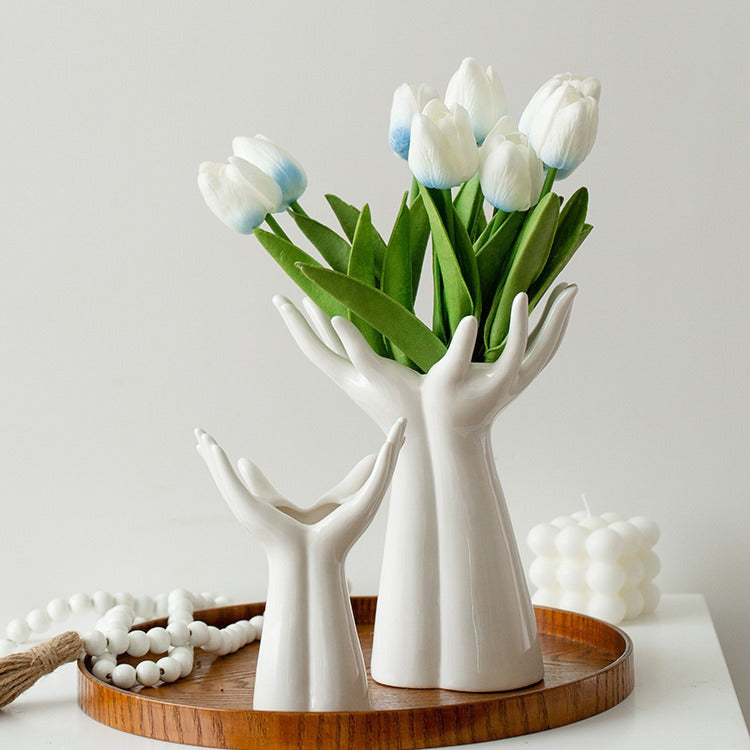
Bathroom or bedroom. A small matte vase on a tray with folded towels brings the same quiet discipline to private rooms.
Mantel or shelf anchor. Mirror one vase at each end of a mantel, or let a single piece own the center with art above.
Three rules that make empty vases look intentional
- Leave negative space. An empty vase needs more clearance around it than a full arrangement — about half its height on each side.
- Repeat a material. Ceramic next to linen, wood or paper keeps the grouping calm and cohesive.
- Match weight to surface. Tall, top-heavy pieces belong on sturdy consoles; light textured bud vases suit shelves and books.
Frequently Asked Questions
Is it okay to leave a vase empty?
Yes — sculptural vases are designed to work as standalone objects. If the form is interesting, empty is often the strongest look.
What looks best in a tall floor vase?
Tall dried branches — pampas, bamboo or manzanita — fill the vertical space without needing water or maintenance.
How do I keep dried stems in place?
Use a narrow-neck form, or add a hidden floral frog or a criss-cross of clear tape across a wide mouth.
How do I style a vase with a busy glaze or pattern?
Isolate it. A single patterned piece styled alone reads as intentional; paired with clutter it reads as noise.
Ready to try it? Browse our sculptural ceramic vases — every form in the collection is designed to hold its own, with or without flowers.